by Lisa Novick
Nonfiction
On a hot summer day that reeked of baked asphalt, I was driving to a new garden at a Los Angeles elementary school, anxious about what I’d find. California was suffering its hottest drought in recorded history, and the garden was surrounded by heat-radiating sidewalks, driveways, and parking lots. When I’d designed the garden, a collaboration between LA’s BEST Afterschool Enrichment Program and the Theodore Payne Foundation, I’d included many locally native species, but even in the best of times, not all plants in new gardens survive.
Exiting the freeway, I saw a sunburned woman in a tank top and shorts at the end of the off-ramp. She was sitting on a crate in the blade-thin shade of a light pole, a shopping cart with tattered, neatly stacked bags of belongings by her side. On a grimy piece of cardboard, she’d printed in black marker, lines straight: Will work for food. Anything will help. God bless. Duct-taped to the top of the cardboard was a stick with a little American flag.
Hunched, virtually expressionless, the woman watched my car—an old compact—roll to a stop at the red light. I motioned to her, and she arthritically pushed herself up.
I handed her my lunch. “It’s all I’ve got,” I said, “I’m sorry.”
She took the food with both hands. “I love bananas,” she said, her smile more gum than teeth. I wondered how she’d chew the trail mix.
The light turned green. Backing away, she winced with every step.
“Wait,” I called after her, rummaging through my backpack for some cash. Horns blared as I thrust a couple of crumpled dollar bills out the window.
“You’re so kind,” she said, pocketing the money with a worried glance at the man shouting obscenities in the SUV behind me.
I hurriedly pulled away, not feeling kind but privileged—and angry: Angry that so many people were falling through the cracks (about 30,000 people were unhoused in Los Angeles in 2016, the number now much higher). Angry that even for people with full-time jobs, housing was precarious.
The man accelerated past the first chance he got, then cut in front of me, braked, and flipped me off. I dropped back until he got bored and roared away.
Driving north on Sunland Boulevard, I wondered where the woman spent her nights. Shopping carts weren’t allowed in shelters, so it seemed likely she was sleeping rough—perhaps amid the boulevard’s hodgepodge of rundown strip malls, gated two-story apartment complexes, bargain mini marts, fast-food joints, and discount liquor stores … or in one of the tent communities nearby. Every unfenced vacant lot seemed to have one, as did bushy areas of parks and shady sidewalks beneath freeway overpasses—tents, shopping carts, and scavenged items crammed into whatever space was available. Some of the communities were tidy, but most looked like maelstroms of refuse: half-collapsed sunken-sided tents among splintered pallets, cracked plastic buckets, torn umbrellas, three-legged chairs, heaps of soiled clothing. With her neat bags and careful printing, did the woman sleep in a place like that?
I turned east on La Tuna Canyon Road, the cityscape suddenly changing to church compounds and ranch-style houses on large lots. Despite Los Angeles’ need for high-density affordable housing, zoning laws favored single-family homes, and still do: apartments are permitted on less than a quarter of the residential land. The results, predictable: a housing shortage and an ever-increasing number of people unhoused or housing-insecure, the cost to rent or buy in Los Angeles well over two times the national average, the price of housing soul-suckingly insurmountable for far too many people. For a city with a protracted housing crisis, the zoning laws made no sense—until understood through the antiquated “vision” of what Los Angeles should look like: an unnaturally green landscape of single-family homes—a throwback to the 1950s, when large parts of the city were agrarian and the population was about half of its current number.
The La Tuna canyon community was one of the last equestrian neighborhoods within Los Angeles city limits, with horse corrals and stables on many of the lots. Like most of Los Angeles, the lots had been scraped of native vegetation but for the occasional sycamore or oak. Planted instead: lawns, palms, bamboo, and other water-thirsty ornamentals virtually sterile of animal life. For a city in a biodiversity hotspot with recurring drought, the landscaping made no sense. Chalk up another win for throwback aesthetics. Since California’s colonization, more than three-quarters of its original landscape has been lost: 341 species are now listed as threatened or endangered, from manzanitas to bumblebees to evening-primroses to frogs.
Vinedale Elementary’s new native garden was an effort to bring a little nature—birds, bees, butterflies, and the plants they need—back into local children’s lives.
Driving up to the school, I craned my neck for a glimpse of the garden. Cars and dumpsters obstructed my view. Moments later, an exuberant collage of green appeared: dark mounds of California buckwheat, gray-patinaed patches of white sage, seafoam mosaics of Palmer’s Indian mallow, and airy exclamations of Catalina cherry. The garden looked like it was thriving!
Don’t count your chickens, I thought. You won’t really know how the garden’s doing until you’re in it. Every garden has its surprises: plants do well in “iffy” spots, or struggle in prime places, or grow to twice the size expected—there’s always something.
I parked in the main lot, grabbed my basket of tools, and hurried across the blacktop, my sunglasses and wide-brimmed hat barely mitigating the glare. Amid all the hard surfaces, the softness of the garden was a relief. Grapevines were already climbing high through the garden’s perimeter of chain-link fence. I wove a few tendrils back into the mesh, then took a quick inventory: California fuchsia, white sage, mountain lilac, coyote mint—every single plant had survived, more than a dozen species in all! I found tiny solitary bees visiting the verbena’s crowns of small pink flowers, a hummingbird sipping nectar from the Cleveland sage, and goldfinches swaying on the evening-primrose’s spires of seed. And hidden among the fuchsia and buckwheat branches were caterpillars—the main food of baby birds. After less than a year in the ground, the native plants were already doing their bit for the food web.
I began digging out some of the invasive palm seedlings pushing up through the mulch. They were depressingly profuse. A dense cluster had sprouted under the billowing Cleveland sage. Reaching into the shade beneath the bush, I noticed some weirdly bright patches on the ground. At first, I thought they were patches of sunlight, or distortions in the scratched, sunscreen-smeared lenses of my dark glasses. But then I saw strands of lavender, pink, and blue. I gently pushed aside the branches for a better look.
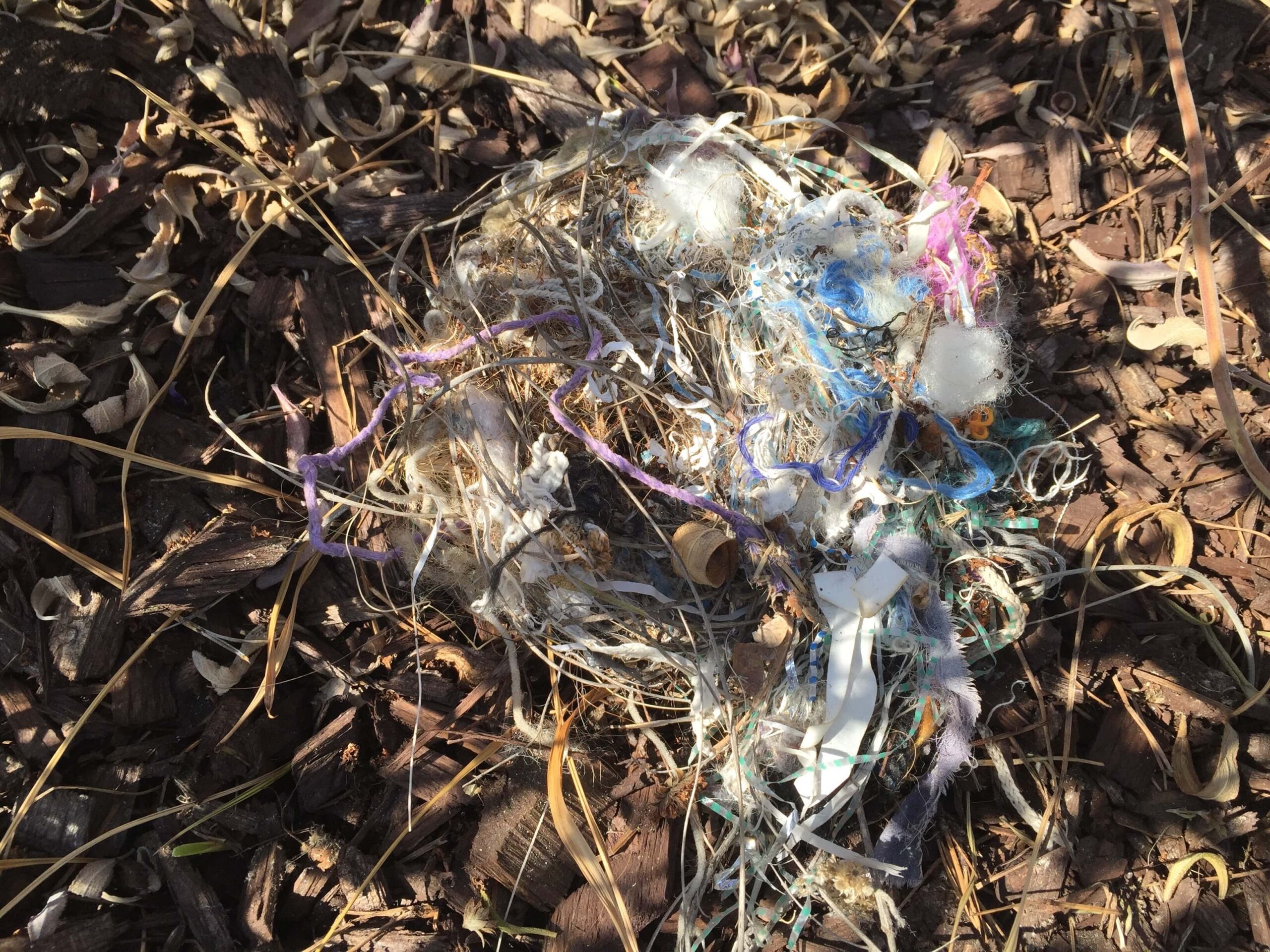
The weirdly bright thing was a nest.
About eight inches across, it was made of white cotton balls, string, strips of fabric, shredded paper, hair ties, strands of yarn and embroidery thread, blood-tinged surgical tape, and plastic garbage ties woven into a thin base of grasses and twigs. California towhees—round, tawny-brown birds with a distinctive backwards hop—sometimes include trash in their nests’ outer cup, the females building while the males look on. This nest had trash throughout, the outer and inner cups an indistinct jumble of items scavenged from paper-plate art projects, the nurse’s office, and the school yard.
Looking around the garden, I felt like a fool: I hadn’t included any bunchgrasses.
When I’d designed the garden, I’d planned for flowers, seeds, and berries throughout the year and caterpillars at nesting time, but I hadn’t planned for nesting material. In a withering drought, the towhee had found a place with food for her young, but few materials for constructing shelter. Caterpillars were non-negotiable—without them, her nestlings would starve. No wonder the towhee had resorted to so much trash.
Then, remembering the design process, I felt a rush of shame. My omission of bunchgrasses wasn’t simply a foolish oversight. I had deliberately excluded them. My reasoning at the time: whether I use warm- or cool-season species, the bunchgrasses will go at least partially dormant sometime during the year—warm-season grasses in winter, cool-season grasses in summer. No amount of supplemental water will “make” the grasses stay green year-round. Many Angelenos, conditioned by the dominance of evergreen water-thirsty ornamental gardens, perceive dormant plants as “ratty looking.” This discourages people from planting native species—not an outcome I wanted to produce, particularly since the garden is front and center at the school.
Whatever my reasoning, I’d deprived the towhee and other birds of nesting material because of throwback aesthetics—the same aesthetics that make single-family homeowners fight higher-density, low- and middle-income housing.
I thought of the woman on the off-ramp.
How many more Angelenos will become unhoused in service of those aesthetics? How many more native species will edge closer to extinction? For our neighborhoods and gardens, when will we embrace a vision with habitat at its core? Habitat not just for some, but for everyone and everything: people and wildlife. Habitat for all.
Lisa Novick works as a grant writer and educator. She was a member of Los Angeles Mayor Garcetti’s Biodiversity Expert Council and Urban Ecosystems Working Group, and was director of outreach and K-12 education at the Theodore Payne Foundation for Wild Flowers & Native Plants. She cofounded Landscape Integrity Films and Education (on YouTube), whose work has been supported by water districts in Southern California. Her writing has appeared in About Place Journal, Camas, Canary, The Hopper, Sky Island Journal, Wild Roof Journal, and elsewhere.