by JR Fenn
2nd Place Winner – Flash 405, August 2025: “Normal”
Fiction
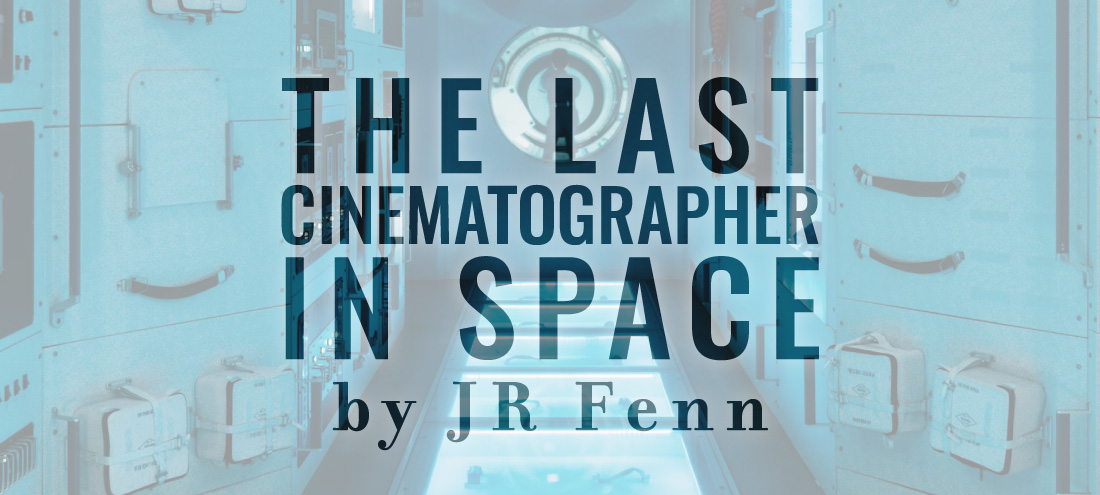
It wasn’t the tilting planets the cinematographer filmed, or the asteroids drifting along, pitted and missing hunks at their edges, or even the vastness of the universe, dropping away behind the ship in trails of distant nebulas. Somehow, this cinematographer was drawn to the ship’s interior—the rows of freeze-dried ice cream gleaming in foil packages, the toilet cubicles with their vacuum-pack apparatus deep in the seat, the plant lab with vials of agar holding tiny seeds and roots.
He floated along, the hallways long and white and sterile. He held his camera to his eye with both hands, propelling his suited body with a toe, the railing spooling past in the foreground of the frame so smoothly it reminded him of the horses turning the bend on the racetrack, the camera following on its invisible, oiled wire after their pounding hooves.
He filmed on nitrate, of course. The cotton fibers, like the light bulb filament, glowed from within. Only one theater on Earth retained permissions to project these highly flammable reels. Several conflagrations had destroyed most of the nitrate archives of the early twentieth century. All of those gleaming interiors captured on cellulose—champagne bottles, silverware, chandeliers, mink wraps, veils, candle sconces, window glass, streetlamps, horses with trappings, marble stairs, angel doors, velvet-decked ballrooms with balconies of musicians—gone up in smoke. And gone, too: the feathery-voiced starlets with their lead-powdered faces, and the leading men, their gestures exaggerated, their penciled brows passionate and harrowed.
The cinematographer’s masterpiece went to Cannes, the festival marred only slightly by unseasonable storms that brought power outages, floods, and upended palm trees. He watched the live feed from space, a pouch of Prosecco in his hand. He won the Lame Duck Award, but he toasted the screen anyway, confident that he wouldn’t meet the same fate as the Russian space
dog, Laika, whose anticlimactic end had inspired the year’s most popular Eurovision song.
But space travel, like everything, carries its risks. A pile of hay for the guinea pig mascot, Sparky, spontaneously combusted. The fire ran through the ductwork, ignited the engines. Life support would fail in a matter of weeks. But the cinematographer continued to gather his footage. His favorite shot was of a rope in space, curling into the distance like a luminescent tapeworm, nothing attached to its end. Next to the rope, a tiny, gleaming speck: someone’s lipstick cartridge, opalescent pink, half-used. He was overtaken by tenderness for all the discarded items he’d never met. He put his thumb to the ship’s window and left a fingerprint-shaped smudge, a mark of his presence, as if to say, Once, my dear friends, this gaffer was fabulous.
Judge’s Comments: What’s not to love? Language, imagery, pacing, emotion—the end’s musicality. Elements that, in their perfect ratio, make for a sucker punch to the gut. When it comes to subject matter, fewer states feel more constant than yearning, fewer realms more normal than the dreams our hearts inhabit.
JR Fenn’s writing has appeared in many places, including Boston Review, DIAGRAM, Split Lip, PANK, 100 Word Story, the Bath Flash Fiction Anthology, and the Bristol Short Story Prize Anthology. She’s a recent graduate of the MFA program at Syracuse University, where she was awarded the Joyce Carol Oates Prize in fiction. Other recognitions include the Gulf Coast Prize in Nonfiction, the 59th Annual New Millennium Award for Flash Fiction, and Stone Canoe’s 2025 Robert Colley Prize for Fiction. Her chapbook, Tiny Vessels, won The Masters Review Chapbook Open and will be published in February 2026. She lives in Western New York with her family. More at www.jrfenn.com.
Photo by Jack Dong